
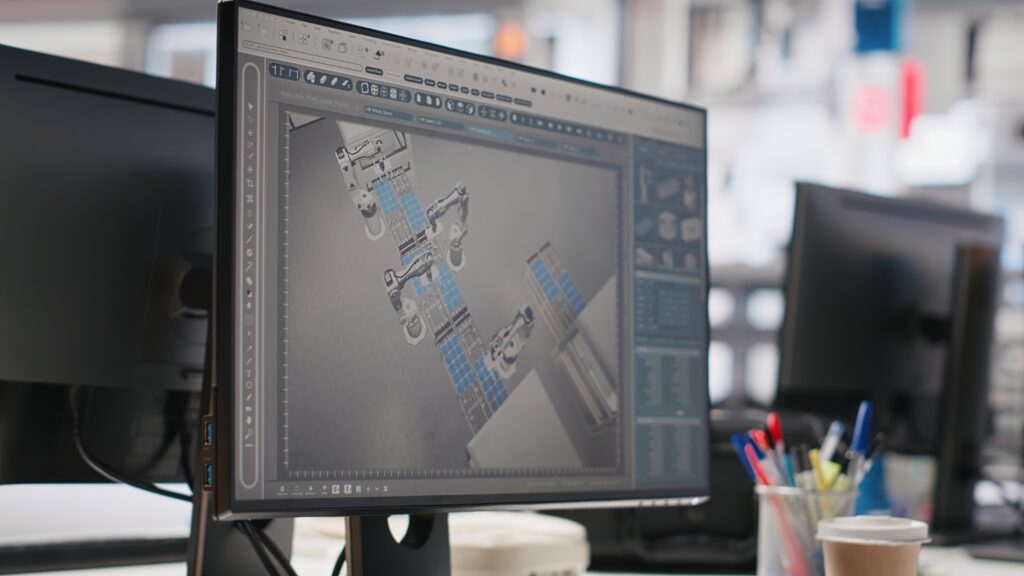
A technical idea can be described in words, shown in a sketch, or built as a prototype. But when preparing a patent application, it is important to present the design so that the examiner understands which elements it consists of, how these elements are connected to each other, and how the claimed technical result is achieved.
For this reason, developers often assume that filing an application requires a full production document with dimensions, materials and tolerances. In practice, a patent drawing and working design documentation serve different purposes.
A patent drawing must disclose the essence of the technical solution. A working drawing must contain data sufficient for manufacturing and inspecting the product. In some projects, patent images are prepared first, and after the results of a patent search are obtained, preparation of working drawings for building a prototype begins.
We look at what should be reflected in the patent application materials, how a sketch differs from working documentation, and how artificial intelligence helps automate this process.
Why a patent drawing is needed and what it should show
A drawing in a patent application helps to visually disclose the technical solution. It is especially important when patenting devices, mechanisms, assemblies, equipment and structures that are difficult to explain unambiguously with text alone.
According to Article 1375 of the Civil Code of the Russian Federation, an application for an invention must contain a description that discloses the essence of the solution with completeness sufficient for it to be carried out by a person skilled in the art. If the description refers to drawings, they are also part of the documents required to establish the filing date of the application.
A patent drawing usually shows:
- a general view of the device;
- the main structural elements;
- the relative position of parts;
- the methods of connecting elements;
- functional links between assemblies;
- longitudinal and transverse sections;
- individual complex assemblies;
- the sequence of operation of the mechanism;
- possible embodiments;
- diagrams of flows of media, signals or energy.
The main task is to show the essential features of the invention in the drawing. If the technical result is achieved through a particular arrangement of parts, the shape of a channel, the method of connection or the presence of an additional element, this feature must be clear from the image and consistent with the description.
At the same time, the drawing should not be overloaded with minor details that do not affect the essence of the solution. Excessive information makes reading harder and may create contradictions between the illustrations, the description and the claims.
The current requirements provide that drawings, the three-dimensional model and the description must not contradict each other. Instead of a classical drawing, diagrams, graphs, pictures, tables and other images may be used if they better explain the essence of the development. Photographs are usually used as a supplement and only in some cases serve as the main explanatory material.
That is exactly why patent drawings cannot be considered separately from the text of the application. The number of each element must correspond to the designations in the description, and each important feature must have a clear graphic representation.
How to make a patent drawing: Rospatent (Роспатент) requirements
A patent image is prepared differently from an advertising visualization, an artistic drawing or an assembly drawing for a factory. Its task is to be technically clear, unambiguous and suitable for reproduction in the application materials.
The main Rospatent requirements for drawings provide the following:
- images are made with clear black lines;
- line thickness must remain the same along the entire length;
- shading and coloring are not used;
- the scale is chosen so that details remain distinguishable after the image is reduced;
- the height of letters and numbers must be at least 3.2 mm;
- each illustration is numbered as a separate figure;
- figures are arranged in the order in which they are mentioned in the description;
- images are submitted on sheets separate from the text;
- orthogonal projections are preferred;
- axonometric projection is permitted where necessary;
- sections are indicated by hatching that does not interfere with reading;
- identical elements in different figures receive the same numbers;
- different elements must not be designated by the same number;
- dimensions are usually not indicated on a patent drawing;
- inscriptions are permitted only when the diagram cannot be understood without them.
These rules are set out in the current requirements for application documents approved by Order No. 107 of the Ministry of Economic Development of Russia (Минэкономразвития России).
For example, if a filtration device is claimed, the figures can show the housing, the inlet channel, the filter element, the outlet channel and the relative position of these parts. The sizes of the openings and the exact length of the housing, if necessary, are given in the description rather than on the patent image itself.
In the case of an electrical, hydraulic or kinematic diagram, clear and standardized symbols must be used. The logic of the diagram must also match the described principle of operation.
High-quality preparation of a drawing begins not with drawing the lines but with analyzing the technical solution. First the essential features are determined, then the necessary views, sections and diagrams are selected, after which the elements are numbered and linked to the text of the application.
Preparation of working drawings: how they differ from sketches
A sketch, a patent drawing and a working drawing may depict the same device, but their level of detail differs.
A sketch conveys the general idea. It may be drawn by hand and contain explanations, approximate proportions and a preliminary arrangement of elements. A sketch helps an engineer understand the concept, but it is usually suitable neither for filing an application without further work nor for directly manufacturing the product.
A patent drawing shows the essence of the development and the main relationships between elements. It usually does not contain production dimensions, tolerances, surface roughness or process instructions.
A working drawing is intended for production. It must contain the data necessary for manufacturing and inspecting a part or an assembly unit:
- the shape and geometry of the product;
- the necessary views, sections and cross-sections;
- overall and connecting dimensions;
- limit deviations;
- tolerances of form and position;
- the material and alloy grade;
- surface roughness;
- thread parameters;
- requirements for welded joints;
- coating information;
- heat treatment;
- technical requirements;
- the document designation.
Requirements for working drawings are established by the ESKD (Unified System for Design Documentation). In Russia, GOST R 2.109-2023 “Unified System for Design Documentation. Basic Requirements for Drawings” is in force.
Thus, a patent drawing answers the question: “What does the technical solution consist of?” A working drawing answers a different question: “How exactly should the product be manufactured and inspected?”
Sometimes a customer hands over tasks based on ready-made drawings for preparing documentation for production. In this case, the specialist checks the completeness of the data, corrects designations, adds dimensions, produces a specification and adapts the materials to the capabilities of a specific enterprise.
Equipment specification on a drawing according to GOST
A specification is necessary to determine the composition of an assembly unit, complex or set. It lists documents, assembly units, parts, standard items, purchased components, materials and other items included in the product.
The rules for preparing a specification for mechanical engineering and instrument-making products are established by GOST R 2.106-2019. The standard provides that a specification is prepared as a separate design document, and the components of the product are distributed among the established sections.
Therefore, the expression “equipment specification on a drawing according to GOST” is not always technically accurate. An assembly drawing indicates item numbers, while detailed information about the corresponding parts and assemblies is placed in the specification.
The placement of equipment on the drawing and the specification must be consistent:
- each item on the assembly drawing corresponds to an entry in the specification;
- the names of elements must not contradict each other;
- the quantity of parts must match;
- document designations must be uniform;
- elements absent from the image must not appear without explanation;
- item numbers must be legible without intersecting the main lines.
Patent materials usually do not require a full production specification. Elements are designated by numerals, and their purpose is disclosed in the description of the invention. If a prototype is to be manufactured after patenting, a separate set of working design documentation is prepared on the basis of the patent materials.
Preparing a part drawing for a manufacturing order
When a custom part drawing is required, a patent image or a general sketch alone is not enough. The manufacturer must understand unambiguously what geometry needs to be obtained, what material the product should be made of and what deviations are permissible.
Before passing documentation to production, you need to check:
- whether all dimensions necessary for manufacturing are indicated;
- whether there are no closed dimension chains with contradictions;
- whether datums are defined;
- whether fits and tolerances are specified;
- whether the material grade is indicated;
- whether roughness is designated;
- whether coatings and treatment are described;
- whether threads, chamfers, radii and undercuts are indicated;
- whether welded joints are defined;
- whether the scale is clear;
- whether a 3D model is attached, if it is required for CNC machining;
- whether the file format has been agreed with the manufacturer.
Orders for manufacturing parts from drawings are accepted faster if the documentation package does not require additional clarification. An undefined dimension, an unknown material or a missing tolerance forces the process engineer to ask clarifying questions or to make decisions independently that may affect the result.
It is especially important to distinguish between a nominal dimension and a permissible deviation. For example, indicating the diameter of a hole is not enough if the connection with a shaft, bearing or bushing depends on the fit.
If the developer has only a patent picture, additional steps are usually performed to launch production:
- A 3D model is created or refined.
- The assemblability of the design is checked.
- Materials are determined.
- Strength and other necessary calculations are performed.
- Dimensions, fits and tolerances are assigned.
- Part drawings are developed.
- An assembly drawing is produced.
- A specification is prepared.
- The documentation is checked by the designer and the process engineer.
Thus, patenting and production preparation are related but do not replace each other. The patent set protects the technical solution, while the working documentation makes it possible to manufacture this solution in metal, plastic or another material.
How “POSINT” automatically prepares drawings for a patent application
Traditional preparation of patent materials requires joint work by the inventor, an engineer and a patent specialist. It is necessary to understand the device, identify the essential features, determine the required projections, prepare the images and align them with the text of the application.
“POSINT” automates a significant part of this process using artificial intelligence.
The User enters a description of an idea, device or technology. Existing sketches, diagrams and technical materials can also be used. The system analyzes the information and helps to:
- identify the main elements of the design;
- highlight the features of the technical solution;
- form the structure of the object;
- select the necessary views and sections;
- prepare graphic materials;
- number the elements;
- link the designations to the description;
- form a description of the operation of the device;
- prepare materials for the claims and the abstract;
- conduct a patent search across Russian and foreign sources.
“POSINT” helps to prepare a patent application (for an invention) with drawings and a description of the object, as well as to perform a patent search and analyze analogues. It is recommended that a specialist check the results before the final filing of the documents.
For example, in the case study of the lightly armored buggy, the AI assistant prepared five images: a general view, a bottom view, a longitudinal section, a wheel section and a diagram of a separate module. At the same time, the system identified the features of the development and generated a description of the object.
At the same time, it is important to consider the intended purpose of the result. “POSINT” helps to produce patent images and the basis of the application. If the documentation is to be used directly in production, subsequent engineering review, assignment of dimensions, materials and tolerances, and issuance of working design documentation will be required.
Instead of preparing each diagram manually, the User receives a structured basis that can be checked, adjusted and used for the further preparation of the application.
Conclusion
Patent and working drawings are created for different purposes. A drawing for a patent application must clearly disclose the structure of the development, the interrelation of its elements and the essential features of the invention in the drawing. It helps the examiner understand the principle of operation of the technical solution, but usually does not contain production dimensions, tolerances, materials and machining requirements.
Preparation of working drawings is carried out for manufacturing the product. Such a set includes dimensions, fits, tolerances, information on materials, technical requirements, assembly drawings and specifications. Therefore, a patent image cannot be used as a ready-made custom part drawing without engineering refinement.
Do you have an idea, a sketch or a description of a new device? Upload the materials to “POSINT”. The AI assistant will help you conduct a patent search, identify the essential features and prepare drawings for an application to Rospatent.
Submit a request on the “POSINT” website and prepare a set of patent materials — from the description of the technical solution to drawings and analysis of analogues.