
In the modern world, patent AI is becoming not just a buzzword but a real tool for optimizing patent search on your own and preparing applications. Thanks to the development of artificial intelligence, a procedure that used to require experience and deep knowledge is becoming more accessible even to those encountering intellectual property for the first time.
In this article we will look at 3 real methods of conducting a patent search, and the pros and cons of each method — from standalone AI solutions to specialized services such as the AI assistant “POSINT”.

Method 1: Perplexity Patents — AI Patent Search in Natural Language
Perplexity Patents is a new tool for searching patent information using artificial intelligence, which allows you to ask questions in plain language rather than through complex patent syntax. It is designed to make preparing for patenting simpler and clearer for engineers, researchers and startups.
How it works
- The user enters a query such as “Are there patents for medical diagnostics over the last 3 years?”
- The AI analyzes the query, breaks it down into subtasks and searches for relevant documents.
- The system displays results together with links to the original patent publications and includes an extended search that determines the patentability of an invention even in scientific publications, blogs and repositories.
Pros of Perplexity Patents
- Search in natural language without knowledge of specialized queries.
- Shows information sources directly.
- Indexes not only patents but also related technical literature.
- The agent is available for free in the beta version for all users.
Cons
- The AI may make mistakes in interpreting complex queries — sometimes it returns not entirely relevant results.
- Does not replace classic databases and legal expertise.
- For serious decisions, for example for a patent application with claims and a description, the results still require verification and analysis by a specialist.
- You need to understand patenting yourself, since the AI often makes mistakes, and if you notice them, it replies “okay, you’re right, I’ll redo it”
- A patent application with claims, a description and drawings will have to be written by yourself or by contacting a specialized organization
Method 2: Using ChatGPT to Search for Patents
Many people use ChatGPT as a tool to assist with independent patent search: they ask questions about technical solutions, about the patentability of an invention, or about what similar developments exist.
ChatGPT can help:
- understand the subject area of the technology;
- formulate a set of keywords for the search;
- get an overview of patents in a particular field.
Pros of using AI chatbots
- availability — many services are free or have a free plan;
- convenient communication — you can refine queries and hold a dialogue;
- help draft first versions of descriptions and lists of terms.
Cons
- Answers may be inaccurate and outdated, since the model was trained on data up to a certain period.
- Experience in patenting is required to assess and filter the results.
- Does not replace a full patent search for a dissertation or serious market analysis.
- The AI often makes mistakes, and if you are not well versed in the subject, the neural network may mislead you
Method 3: AI Assistant “POSINT” — Russian AI for Patent Search and Patenting Automation
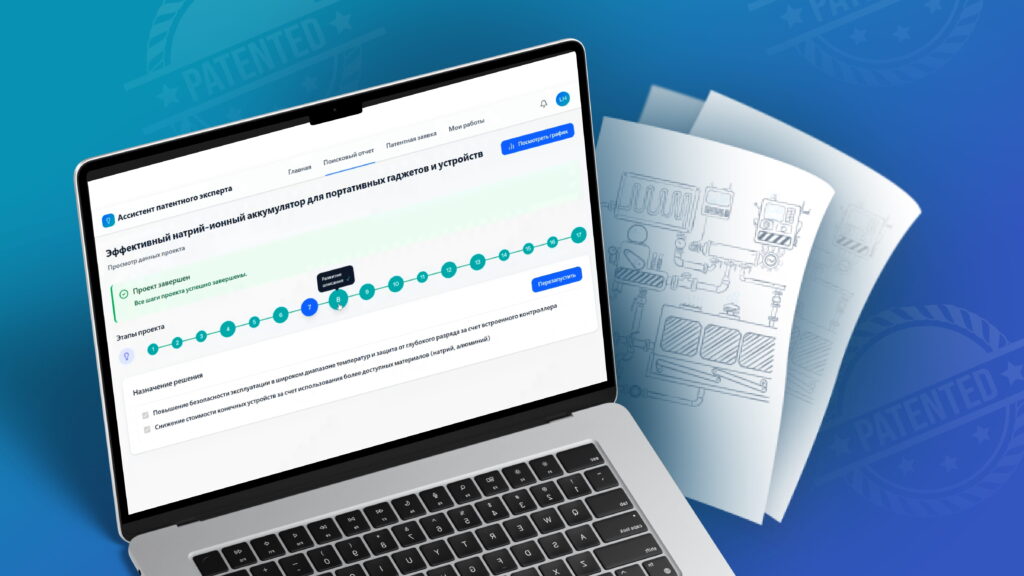
What is the AI assistant “POSINT”
The AI assistant “POSINT” is a Russian artificial-intelligence-based service created so that you can conduct a patent search yourself and automatically prepare an application for Rospatent (Роспатент).
The service positions itself as a patent expert assistant that performs the entire cycle — from searching for patents to generating ready-made materials for filing with Rospatent.
How “POSINT” works
- The user uploads a brief description of their idea.
- The system performs a patent search across databases and delivers a report with analogues in 15 minutes.
- The AI generates a full description of the invention, prepares drawings, checks patent clearance online and generates the claims.
- Ultimately, the user receives a ready application to submit to Rospatent.
Pros of the AI assistant “POSINT”
- Saves money on a patent attorney firm by doing all the work automatically.
- Suitable even for those with no experience who do not know how to do a patent search.
- The tool can conduct international patent search and patent clearance checks.
- Generation of the claims, drawings and description makes the application preparation process much faster.
Cons
- Only the demo meeting is free; the service itself is paid
- The service is still little known on the market
At the same time, in terms of functionality, the AI assistant “POSINT” covers the key tasks: it simplifies and automates conducting patent searches and speeds up the patenting process, which makes it a promising tool for startups, engineers and research teams.
Conclusions
Today AI and automation technologies are changing the very approach to intellectual property. Whereas conducting a patent search used to require long manual work, AI for patent search now makes it possible to obtain a structured analysis in a short time, search for patent information and prepare a basis for further patenting.
Do not put off protecting your idea.
Conduct a patent search yourself today, check your development for uniqueness and take the first step towards registration. The sooner you start the patenting process, the higher the chances of preserving your competitive advantage.