
How the AI assistant “POSINT” drew up a full patent application for a lightly armored buggy in 15 minutes
Story:
An inventor from our team came to the service with an idea: to patent a lightly armored buggy, a reconnaissance vehicle on a tubular frame with a hybrid power plant and reinforced protection.
To do this, it was necessary to conduct a patent search, make sure the design was novel, and assess the patentability of its components: the frame, suspension, tire protection system, and turret. A patent attorney firm would have asked for at least 5–7 days. The AI patent service handled it in 15 minutes: the inventor uploaded the idea and received a ready-made package of documents. Here is how the AI assistant “POSINT” processed the task step by step.
1. Structure generation and visualization (3 minutes)
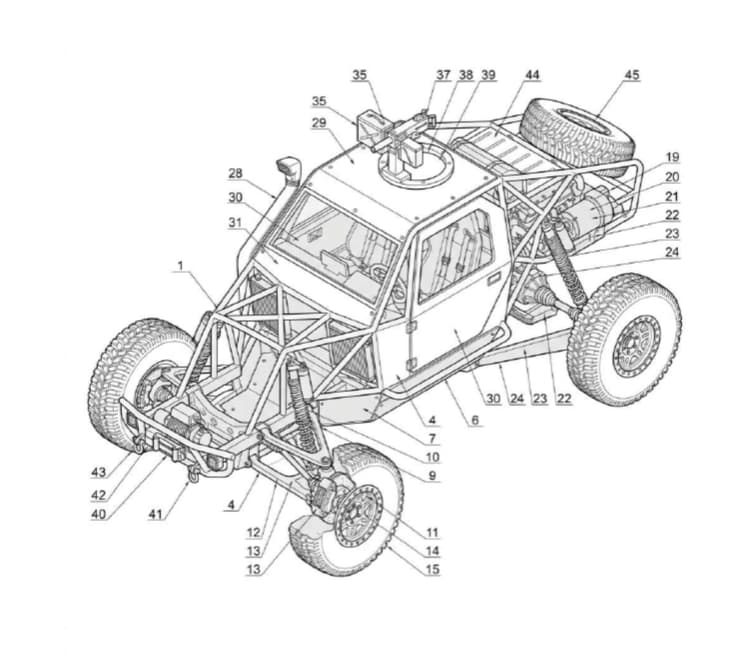
The system generated 5 key drawings:
- General view: frame, crew capsule, turret.
- Bottom view: side members, subframes, armor plate, battery pack.
- Longitudinal section: layout of the internal combustion engine, electric motor, and seats.
- Wheel section: beadlock rim, bulletproof insert, brakes.
- Combat module: turret base, rotating platform, weapon mounting unit.
The drawings were not created from a template but specifically for the applicant’s description.
2. Detailed description of the object (5 minutes)
Based on the idea and the drawings, the AI assistant “POSINT” wrote a detailed description:
- Tubular frame made of 30ХГСА steel with a closed loop of side members and cross members.
- Suspension: front arms, rear trailing arms, gas-hydraulic shock absorbers with remote reservoirs.
- Wheel protection: rims with beadlocks and polymer bulletproof inserts inside the tires, allowing the vehicle to keep moving when punctured.
- Hybrid power plant: coaxial internal combustion engine and electric motor, a sealed battery housing below seat level.
- Turret: an annular base welded to the frame and a sealed bearing assembly.
3. Formation of search features (2 minutes)
The AI structured the solution into a list of 30 features, the basis of the future claims. Among them:
- F1: Frame made of 30ХГСА steel.
- F10: Rims with beadlocks.
- F11: Bulletproof inserts made of elastomer.
- F15: Battery pack below seat level.
- F25: Sealed bearing assembly of the turret.
- F26: Universal weapon mounting unit with dampers.
4. Search for analogues and analytics (5 minutes)
The AI assistant “POSINT” performed the most difficult stage automatically, finding 25 relevant patents (CN, RU, US). For each analogue (A1–A25), the assistant identified the common components and indicated the unique features of the development. For example, analogues A5 and A11 have frames and armor but lack beadlocks with inserts (F10, F11). A21 and A23 have turrets but no sealed bearing (F25).
Result
After 15 minutes, the inventor received a package of documents ready for filing with Rospatent (Роспатент):
- A set of drawings (5 views) with a description.
- A detailed description of the invention.
- 30 search features, the basis for the claims.
- An analytical report with a review of 25 analogue patents and a substantiation of novelty.
Conclusion: the AI assistant “POSINT” made it possible to go from an idea to a professional application in 15 minutes. The AI patent service took over the routine of creating drawings, writing the description, and conducting an in-depth patent search. This is not just a time saving, but an opportunity to quickly assess patentability and launch commercialization without bureaucratic delays.
Other case studies
-
How “POSINT” ran an international patent search for a self-healing textile made from living mycelium
How “POSINT” ran an international patent search for a self-healing textile made…
-
From idea to patent application in 15 minutes: how the AI service “POSINT” helped an inventor prepare patent documents for a sodium-ion battery
From idea to patent application in 15 minutes: how the AI service…