
From idea to patent application in 15 minutes: how the AI service “POSINT” helped an inventor prepare patent documents for a sodium-ion battery
A case study on how our service helped an inventor professionally prepare a patent application in 15 minutes
Story:
An inventor from our team came to the service with an idea: to patent a compact sodium-ion battery for charging personal devices (power bank).
To do this, he needed to conduct a patent search and make sure the design was truly new and did not repeat existing solutions. He also needed to assess patentability: to understand which components can be protected and which are already common knowledge.
At a patent attorney firm, this process would have taken at least a week. Instead, the inventor uploaded the idea to the AI patent assistant, and here is what came out.
The inventor entered a simple, “plain-language” wording into the system: “Sodium-ion battery for personal devices.” After 15 minutes, he received a complete report and a set of documents. Here is how the AI patenting service processed the task step by step:
This video shows how the AI service “POSINT” solves engineering tasks, prepares drawings, conducts an international patent search, and generates a ready patent application, completely online
1. Structure generation and visualization (first 3 minutes)
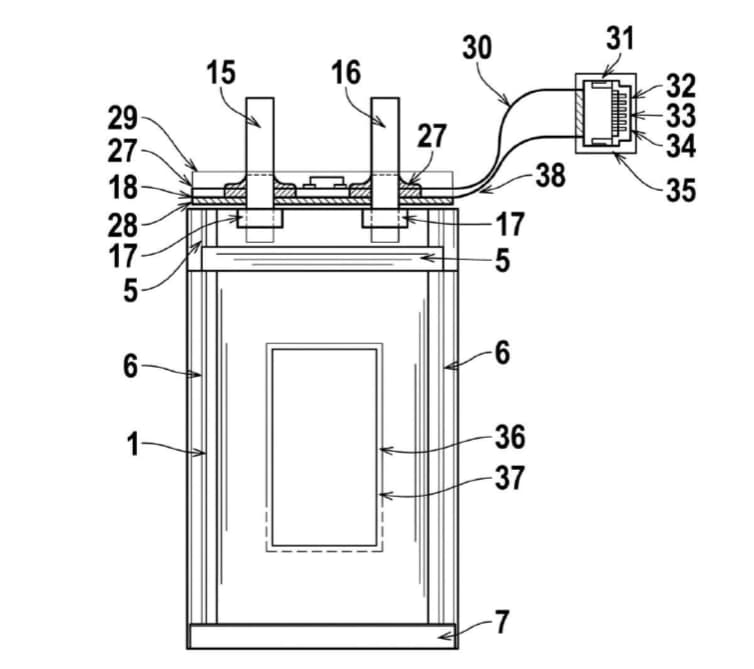
The AI service “POSINT” understands that a patent is not only text but also graphics. The system automatically generated 4 key drawings that visualize the idea:
- General view: “POSINT” showed the casing, the control board, and the flexible cable with a connector.
- Sealing unit: detailed how exactly the aluminum leads pass through the seam and the cuffs.
- Electrode structure: created a layered “stack” structure with alternating anode, cathode, and separator.
- Board layout: placed a microchip, transistors, and a shunt on the board.
This is critically important: the drawings are not created from a template but are generated for a specific text description in order to illustrate the claimed components.
2. Detailed description of the object (next 5 minutes)
Based on the uploaded idea and the generated drawings, the patent AI assistant “POSINT” wrote a detailed description of the finished product. It did not simply list the parts but linked them into a single design, using professional terminology.
- A multilayer casing is described: nylon/PET — aluminum — polypropylene.
- The type of electrolyte is specified: liquid, based on sodium salts.
- A key feature of sodium-ion technology is emphasized: the anode and cathode current collectors and the leads themselves are made of aluminum. For a person versed in the subject, this immediately signals the rejection of expensive copper and a reduction in weight.
- The welding method (ultrasonic/laser) in zone 27 for joining homogeneous aluminum materials is described.
3. Formation of search features (next 2 minutes)
Our patent assistant structured the technical solution into a formalized list of 25 search features (F1–F25). This is the “skeleton” of the future claims of the invention. For example:
- F7: Anode current collector made of aluminum foil.
- F10: Cathode material layer made of sodium-containing oxide.
- F13: Insulating cuff with adhesion to polypropylene.
- F16: Microchip with voltage thresholds for sodium-ion chemistry.
- F24: Compensation volume inside the casing for collecting gases.
4. Analytical part and search for analogues (final 5 minutes)
The most labor-intensive stage for a human, the patent search, was performed automatically by the AI assistant “POSINT”. It scanned databases and found 22 relevant patents.
Our patent assistant did not simply provide links but carried out a comparative analysis. For each analogue (A1–A22), “POSINT” identified the components shared with the inventor’s development (for example, A11 has the same laminate casing and aluminum leads) and indicated the unique features found only in the new development (for example, the location of the thermistor in the zone of direct contact with the leads (F17) or the presence of a connector reinforcing plate (F21).
15 minutes after entering the request, the inventor received a complete package of documents, ready for final review and filing with Rospatent (Роспатент):
- A set of drawings (4 views) with a description of the items.
- A detailed description of the utility model/invention.
- A list of search features (25 items), the basis for the claims of the invention.
- An analytical report on the state of the art with a review of 22 analogue patents and an indication of the novelty of the development.
The “POSINT” service allowed the inventor to go from an abstract idea to a professionally prepared patent application in 15 minutes. Our AI patent assistant took over the routine of formalizing the description, creating drawings, and conducting an in-depth patent search that a person would have carried out over several days. This is not just a time saving, but an opportunity to quickly assess the patentability of an idea and proceed to its commercialization without months of bureaucratic delays.
Other case studies
-
How “POSINT” ran an international patent search for a self-healing textile made from living mycelium
How “POSINT” ran an international patent search for a self-healing textile made…
-
How the AI assistant “POSINT” drew up a full patent application for a lightly armored buggy in 15 minutes
How the AI assistant “POSINT” drew up a full patent application for…